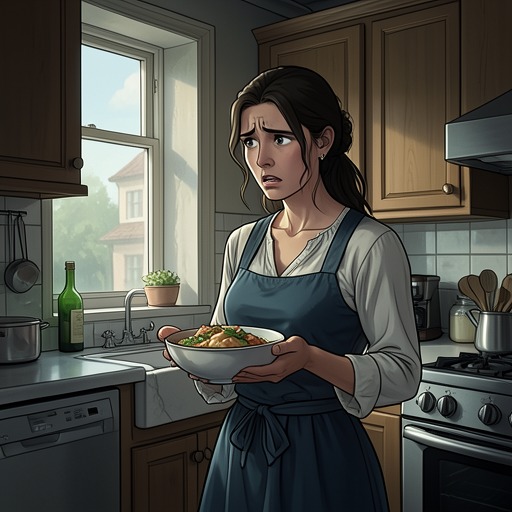
The narrator attempts to make fugu sashimi for Kerrand
Winter in SokchoThe narrator’s attempt to make fugu sashimi for Yan Kerrand turns an offer of care into a precise, solitary task, then ends at the threshold of his absence. The fish is prepared with painstaking attention, but the completed platter reaches Kerrand’s room only after his footprints have vanished into the snow.
The Invitation and the Fish
The offer comes as Kerrand seems exhausted and withdrawn. While the washing machine churns beside them, the narrator invites him to taste her cooking; he looks toward the machine, then murmurs his assent. Before dawn, she goes to the fish market while her mother sleeps. In the dim unloading area, her torch catches octopuses moving in tanks, and her mother’s toothless blowfish float open-mouthed. She chooses the fish she judges most stupid, but when it beats its fins outside the water, she panics and strikes it too hard, smashing its head with her fingers. She wraps it to prevent the head from leaking on the walk back to the guest house.
The meal immediately becomes a test of exactness. After showering and dressing, the narrator tries again to put in her contact lenses, lines her eyelids, and revives dried mascara with warm water. In the kitchen, she imagines her mother preparing the fish and tells herself she will have to do it perfectly. The preparation is therefore not simply the fulfillment of an invitation: it is also an effort to reproduce a demanding skill, carried out while Kerrand remains elsewhere.
The Work of Preparation
The narrator’s care takes the form of close, difficult handling. The Fugu has no scales or spines, yet its skin feels gritty; she cuts off the fins with scissors and lops off the head, only to find the cartilage thicker than expected. A heavier knife cracks through it. She opens the skin along the curve of the abdomen and exposes the viscera, comparing the cut surface to a ripe persimmon. Finding no ovaries, she recognizes the fish as male. With a teaspoon she scrapes away the blood, then uses her fingers to remove the intestines, heart, and stomach without piercing the organs. She frees the small liver delicately, severs it from the gall bladder, turns it in her palm, and seals it in a bag before throwing it away.
Once emptied, the fish resembles a deflated balloon. She washes and rinses it, cuts it into sections, and handles the white fillets, which seem fragile as vapour. Before slicing them with her finest blade, she dabs them with a clean napkin to remove any trace of blood. The blade’s tip vibrates slightly; an hour passes before she finishes. The duration and precision make the preparation a labor of control, but the earlier accident—the blow that smashed the fish’s head—remains part of the same attempt. Perfection is an aim, not a condition she has secured.
She grates radish, mixes rice vinegar and soy sauce for the dressing, and chooses a large ceramic platter inlaid with mother-of-pearl cranes. Arranged across it, the thin Fugu slices are so delicate and feathery that the inlay shows through them. She thinks she would have liked to show the finished dish to her mother, linking the meal not only to Kerrand, whom she invited, but also to the skill she had imagined learning from her mother.
The Delivery and the Empty Room
On the way through Mother Kim’s alleyway, a kitten runs toward the narrator. She balances the platter in one hand and bends to stroke its head; purring, its eyes fixed on the fish, it follows her for several metres, mewling. The encounter briefly places the carefully prepared food before another hungry creature, but the narrator continues toward the guest house with the dish intact.
The courtyard door is open. Across the snow, two fine lines of footprints lead from Kerrand’s room, past the fountain and chestnut tree, and out through the courtyard entrance, where they disappear. The narrator recognizes them as his and stares. Inside, the curtains are drawn and the quilt lies carefully folded; the smell of his breath and incense lingers, while dust drifts through a beam of light above the desk. His frayed canvas sketchbook remains there. She sets the platter on the ground and walks to the window, but the fish has arrived only after its intended recipient has left. The care invested in making it has produced no shared meal: the final movement of the attempt is from invitation to an empty room.
The Offer Left Unshared
The narrator sets the platter on the ground and sits carefully on the bed, trying not to wrinkle the sheets. Dust on the windowsill, unnoticed before, becomes visible in the dimming light; a buzz softens in her ears as the room’s contours blur. She looks from the fish to the ink stain at the foot of the bed, imagining that this trace, too, will fade. Then she picks up the frayed sketchbook and opens it. The attempt to make a meal for Yan Kerrand ends not in his tasting it but in this quiet change of attention: the carefully prepared fish remains on the floor, while the object he left behind becomes the next thing she will look at.